Payment Solutions
Your one-stop destination for seamless account opening and secure money transfers, catering to both individuals and businesses.
Operate Domestically and Internationally to expand your horizons

Multi-currency corporate and personal accounts
You can open corporate and personal accounts in different currencies and get access to a wide range of money management tools. With WWPi you gain greater control over your business payment requirements.

Do business across borders
Effortlessly transfer funds in more than 140 currencies including USD to 160+ countries around the world. It unlocks the whole world to your finances.
We consider complex cases and structured deals for free
Structuring non-standard solutions using the capabilities of Wise Wolves Corporation.
What we offer

140 currencies
including USD

Individual
application review

10 languages: multilingual
assistance team

Desirable currency
exchange rates

Fixed SEPA
transfer rate

Quick internal and
external funds transfer

Current account
with European IBAN

Convenient
maintenance fees

Fast SWIFT
transfers
Pi-online
Access all payment tools with our user-friendly Pi-Online
or WWPi Mobile Office to make payments quickly and easily.
European Payment Service Provider under Central
Bank of Cyprus Payment Institution license.
- Member of the Cyprus Association of Electronic
Money and Payment Institutions (ACEMPI) - Direct participant of SWIFT
(WWPICY2L) EU countries
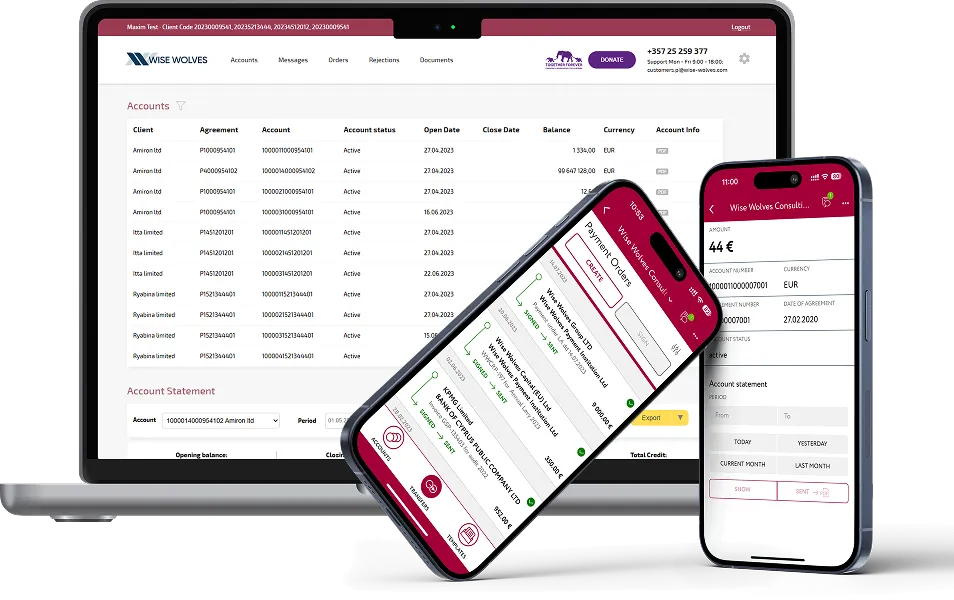

Experience the difference of human-centered service with WWPi

At WWPi we pride ourselves on delivering a human touch. Unlike automated bots, we are real people here to assist you every step of the way.
With us, you'll have your own private manager, providing personalized support for all your needs. From addressing inquiries to resolving issues, your dedicated manager is there for you one-on-one.
Our multilingual team speaks over 10 languages, ensuring seamless communication regardless of your preferred language.


Experience top-tier
service without the
hefty price tag

Our pricing
No hidden fees, no surprises.
| Service | Fee |
|---|---|
| Account opening | € 200 |
| Account maintenance monthly fee | € 10 |
| Transfers | |
| Inward payments | |
| SEPA payments | 0,05% / min € 5 – max € 50 |
| Non-SEPA payments | 0,20% / min € 17 – max € 350 |
| Internal payments (charged from payer’s account) | |
| Payments within WWPi (in any currency) | € 5 |
| Between my accounts (in any currency) | free of charge |
| Outward payments | |
| SEPA payments | 0,10% / min € 5 – max € 150 |
| Non-SEPA payments | 0,30% / min € 50 – max € 350 |
Just one two three
We agree on the
necessary documents
After verification,
your account is open
Our partners
We cooperate only with true professionals




Become our referrer
Join forces with us and unlock new business opportunities. Become our referrer. Together, we can achieve more.
Become a referrerCommon Questions
Our Company is a Payment Institution.
In the European Union (EU), a Payment Institution (PI) is a regulated entity that provides payment services. The institution is licensed to offer a range of payment services, such as money remittance, executing payment transactions, issuing payment instruments (like cards), and operating payment accounts.
We are licensed by Central Bank of Cyprus. Please visit the CBC’s site: https://www.centralbank.cy/en/licensing-supervision/payment-institutions/licensing-and-supervision-of-payment-institutions
Here are the key differences between Payment Institutions (PIs) and banks:
- Scope of Activities.Payment Institutions:
- Focus exclusively on providing payment services, such as executing payment transactions (e.g., transfers), issuing payment instruments (like cards or e-money), and providing payment accounts.
- PIs do not engage in traditional banking activities like lending, deposit-taking, or providing credit facilities.
Banks:
- Offer a broader range of financial services, including deposit-taking (holding customer funds), providing loans and credit facilities, investment services, and other banking-related activities.
- Banks typically operate under a banking license and are subject to more extensive regulatory requirements due to the complexity and risk associated with their activities.
- Regulatory Framework.Payment Institutions (PIs):
- Regulated under the Payment Services Directive (PSD) or PSD2 in the EU.
- The regulatory requirements for PIs focus on ensuring the security, efficiency, and integrity of payment services, consumer protection, and the prevention of money laundering and terrorist financing.
Banks:
- Regulated under banking laws and regulations, which are generally more comprehensive and cover a wide range of activities beyond payment services.
- Banks are subject to prudential regulations aimed at safeguarding financial stability, including capital adequacy requirements, liquidity management, and risk management standards.
- Deposit Protection.Payment Institutions (PIs):
- Generally, do not offer deposit-taking services. Therefore, customer funds held by PIs are not covered by deposit guarantee schemes, which protect deposits in case of the institution’s insolvency.
Banks:
- Offer deposit accounts to customers, and deposits held with banks are typically covered by deposit guarantee schemes up to a certain limit (e.g., €100,000 per depositor per bank in the EU).
In summary, Payment Institutions (PIs) in the EU specialize in providing payment services and are subject to specific regulations under the Payment Services Directive. Unlike banks, PIs do not engage in traditional banking activities such as deposit-taking and lending. Banks offer a broader range of financial services, including payment services, and are subject to more comprehensive regulatory oversight due to their systemic importance and the nature of their activities.
In the European Union (EU), a Payment Institution (PI) is a regulated entity that is licensed to provide payment services. Payment Institutions are governed by the Payment Services Directive (PSD) framework, which aims to harmonize payment regulations across EU member states and ensure a level playing field for payment service providers.
Key characteristics of Payment Institutions include:
- Scope of Services. Payment Institutions offer various payment services, including:
- Execution of payment transactions (such as credit transfers, direct debits, and card payments).
- Issuing and/or acquiring payment instruments (like credit cards, debit cards, and payment apps).
- Money remittance services.
- Payment initiation services (facilitating direct bank transfers initiated by customers).
- Regulatory Requirements. Payment Institutions must obtain authorization from the relevant national competent authority (such as the financial supervisory authority of the member state) before commencing operations. They are subject to specific regulatory requirements set out in the PSD, including capital adequacy, governance, operational standards, and consumer protection measures.
The differences between Payment Institutions (PIs) and Electronic Money Institutions (EMIs):
Payment Institution (PI).
- Focuses primarily on providing payment services, such as executing payment transactions and issuing payment instruments.
- Does not issue electronic money as its core activity.
- Regulated under the Payment Services Directive (PSD) framework.
- Not permitted to engage in traditional banking activities like accepting deposits or providing credit services.
Electronic Money Institution (EMI).
- Specializes in issuing electronic money, which is a digital representation of fiat currency stored on electronic devices (e.g., prepaid cards, e-wallets).
- Can also provide payment services similar to PIs, including executing payment transactions and issuing payment instruments.
- Regulated under the Electronic Money Directive (EMD) framework.
- Subject to specific capital requirements and governance standards tailored to electronic money issuance and payment services.
In summary, while both Payment Institutions (PIs) and Electronic Money Institutions (EMIs) are regulated entities that provide payment services, they differ in their core activities and regulatory frameworks. PIs focus on payment services without issuing electronic money, whereas EMIs specialize in issuing electronic money alongside offering payment services. The regulatory directives (PSD for PIs and EMD for EMIs) provide specific guidelines to ensure the safety, efficiency, and integrity of payment systems within the EU.
No. In accordance with an order of The Civil Registry and Migration Department of Cyprus, you can open account for this purpose only in Credit Institutions.
Please refer to the link: https://www.centralbank.cy/en/licensing-supervision/banks/register-of-credit-institutions-operating-in-cyprus
No. In accordance with an order of The Civil Registry and Migration Department of Cyprus, you can open account for this purpose only in Credit Institutions.
Please refer to the link: https://www.centralbank.cy/en/licensing-supervision/banks/register-of-credit-institutions-operating-in-cyprus
EUR, USD and other 140+ currencies. For more details, please contact with our managers.
Yes
For this purpose, please contact us by any convenient for you ways:
- Send a request to customers.pi@wise-wolves.com ,
- Call to the Customers’ Support Department: +357 25 259377,
- Visit our office personally.
In our Payment Institution you can open the following types of accounts:
- Operational account.
- Client’s account.
- Escrow accounts.
You will receive your credentials for using of your personal account and the relevant guides after account opening.
Our licence
Wise Wolves Payment Institution Limited has obtained in a due course of company's assessment by the Central Bank of Cyprus, the Authorisation (licence) for provision of payment services to its customers.
In the Republic of Cyprus the provision of payment services and execution of money transfers is regulated by the Provision and Use of Payment Services and Access to Payment Systems Law of 2018 ("Law"), which transposed into national law the provisions of Directive (EU) 2015/2366 of the European Parliament and of the Counsil of 25 November 2015 on payment services in the internal market (commonly known as PSD2).